Constant functions output the same constant regardless of input, eg. $f(x) = k$.
Identity functions output the input, eg. $f(x) = x$
Properties of limits:
$f(x)$ and $g(x)$ are functions where $\lim\limits_{x \to a}{f(x)} = L$ and $\lim\limits_{x \to a}{g(x)} = M$. Then the following properties are true:
$$\lim\limits_{x \to a}{f(x) + g(x)} = L + M$$
$$\lim\limits_{x \to a}{f(x) * g(x)} = LM$$
$$\lim\limits_{x \to a}{\frac{f(x)}{g(x)}} = \frac{L}{M} \text{ if } M \neq 0$$
This is meant to teach us that you can break apart limits into multiple pieces, see example.
All polynomial functions are continuous, so to get the limit you can just plug in.
Limits of a case where you divide by zero:
If $f(x)$ and $g(x)$ are equal, but $f(x)$ breaks continuity at $a$, then $$\lim\limits_{x \to a}{f(x)} = \lim\limits_{x \to a}{g(x)}$$
Factoring a polynomial is the same as finding its roots. If $a$ is a root of a polynomial $f(x)$ then $(x - a)$ is a factor of $f(x)$.
$\lim\limits_{x \to -1}{\frac{x^2-x-2}{x^2-4x-5}}$ can’t be plugged in as you’ll get $\frac{0}{0}$. But you can factor and divide: $$\lim\limits_{x \to -1}{\frac{x^2-x-2}{x^2-4x-5}} = \lim\limits_{x \to -1}{\frac{\sout{(x+1)}(x-2)}{(x-5)\sout{(x+1)}}} = \lim\limits_{x \to -1}{\frac{x-2}{x-5}} = \frac{1}{2}$$
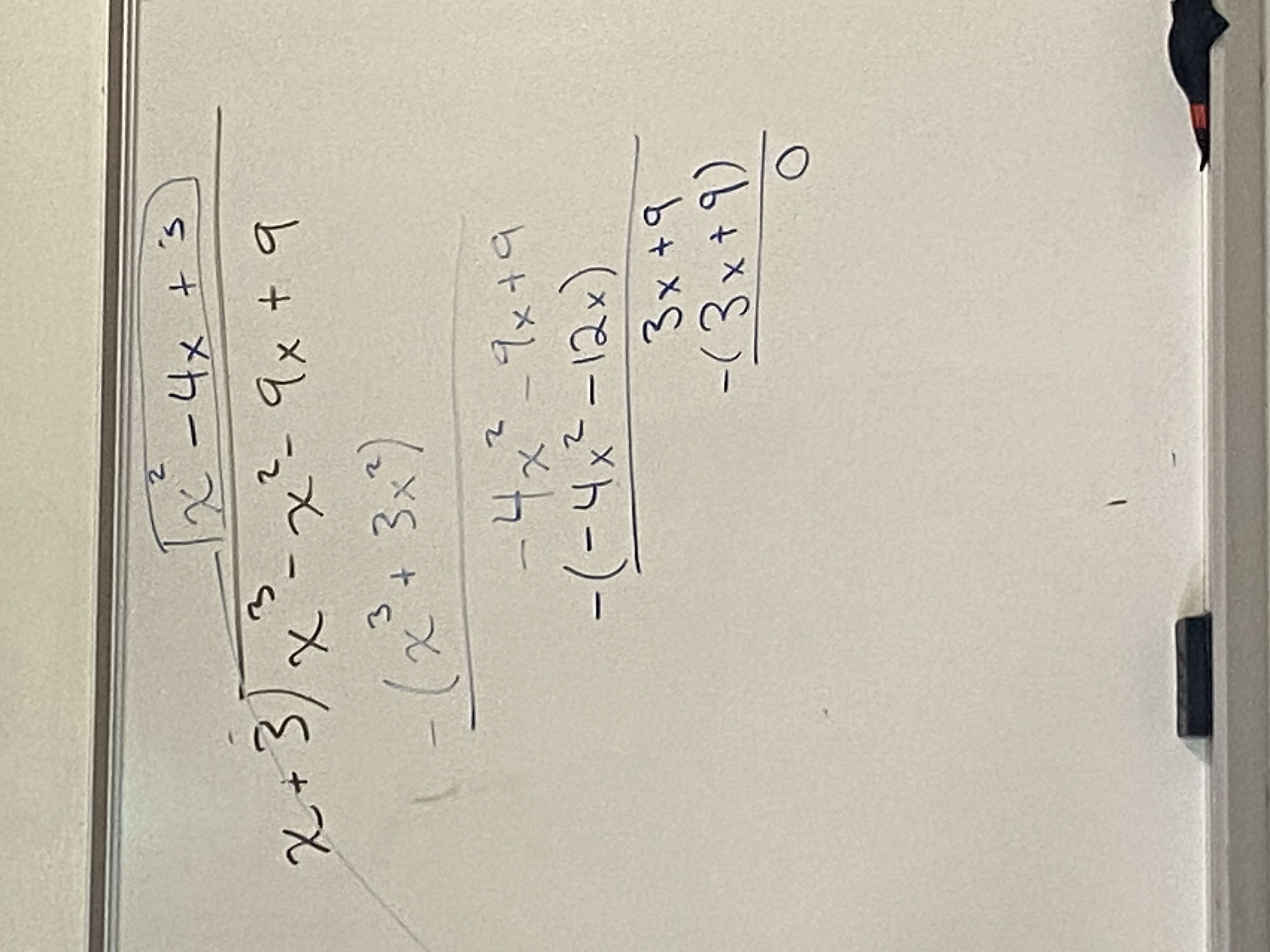
Complex example: $$\lim\limits_{x \to -3}{\frac{x^2-2x-15}{x^3-x^2-9x+9}}$$ We know the root of the denominator is $-3$ because the denominator evaluates to $0$ when $x=-3$. So we divide the denominator by $x+3$. See this khanacademy video to long divide the polynomial into a quadratic, then get the roots the same way you did in the last example. I took a picture of the long division.
You should get $\lim\limits_{x \to -3}{\frac{x^2-2x-15}{(x+3)(x^2-4x+3)}}$ from the long division of the polynomial. Factor your polynomials: $$\lim\limits_{x \to -3}{\frac{\sout{(x+3)}(x-5)}{\sout{(x+3)}(x-1)(x-3)}} = \frac{-8}{24} = \frac{-1}{3}$$
A similar example will be on the lab and likely will give students the most trouble.